
CUSTOMER STORY
FLÂNEUR is an Amsterdam fashion label founded in 2019 by Regi Schalks, built on the idea of the urban explorer: observing the city and translating its codes into garments. Tees, long sleeves, hoodies, tailored trousers and denim, released in collections and capsules, GOTS-certified production, a boutique in Amsterdam and the FLÂNEUR+ membership. Sold online across Europe and beyond.
Industry
Fashion, streetwear
Location
Amsterdam, Netherlands
Platform
Shopify Plus
Powered by
Twini, AI product assistant
conversations handled
products added to cart
products sold by Twini
Challenge:
FLÂNEUR sells premium fashion online, in drops, across 173 products. Every page raises the same doubts, sizing first, and at €100+ per piece an unanswered question doesn't just cost the sale, it comes back as a return. Multiply that by every new capsule and market.
Solution:
FLÂNEUR put Twini, an AI assistant, on its product pages: it answers sizing from how a shopper usually fits, suggests what to style each piece with, and handles delivery and returns. Every chat then feeds a per-product map of what shoppers keep asking, and the gaps worth fixing.
One question, asked on every one of 173 pages
FLÂNEUR's silhouettes are considered: relaxed cuts, oversized fits, tailored pieces. Which makes the oldest question in fashion ecommerce even sharper. Across markets, shoppers land on every product page asking:
What size should I take?
What size does the model wear?
Does it fit oversized or true to size?
What material is it made of?
Is this piece for women or men?
When will my size be restocked?
How long does delivery take?
A size guide answers some of that, for some people, on some pages. But FLÂNEUR releases in drops and capsules, so new pages appear all the time, and each one resets the questions. At this catalogue size, no team can answer them all by hand.
An assistant that sizes, styles and sells on every page
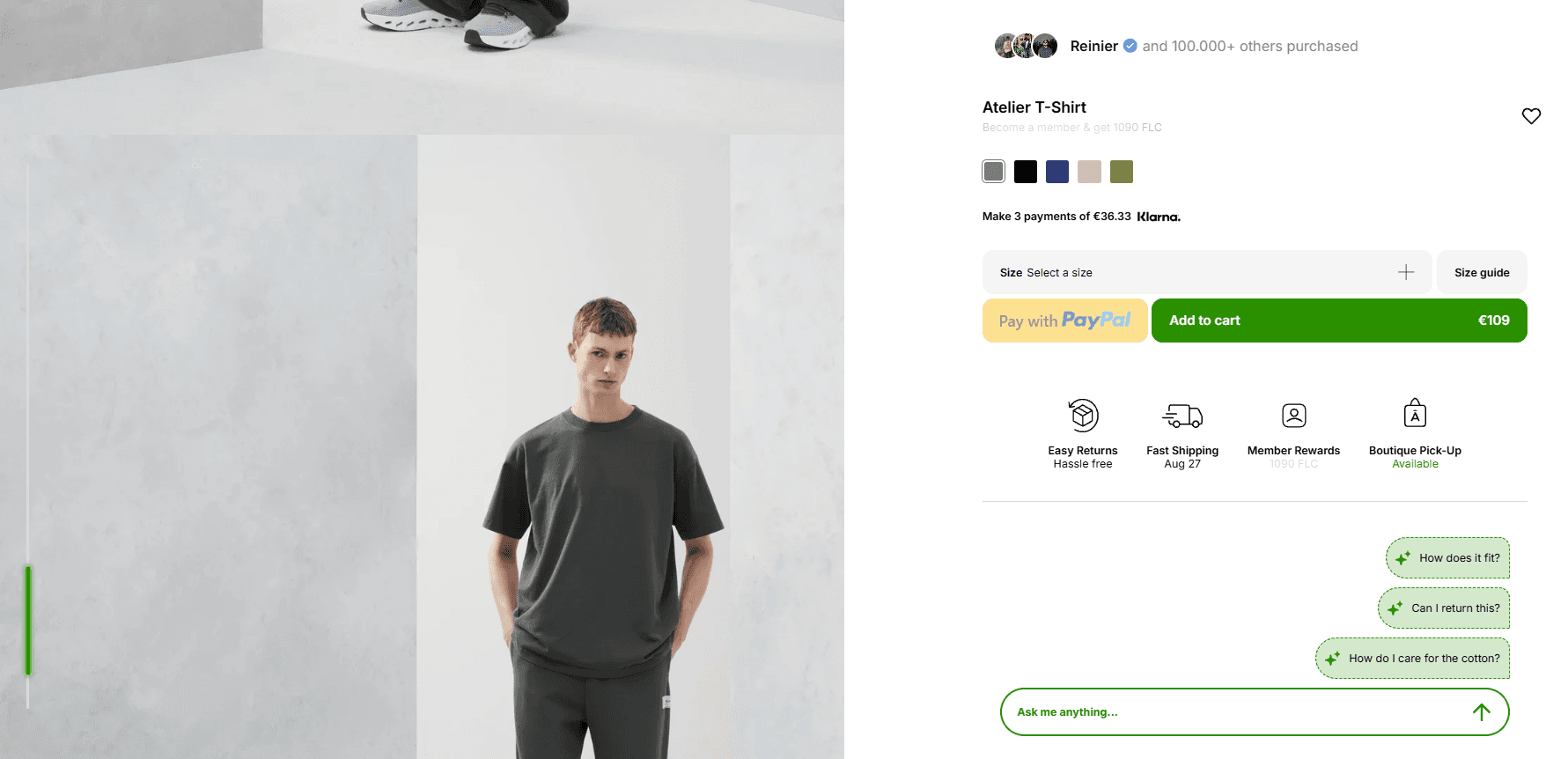
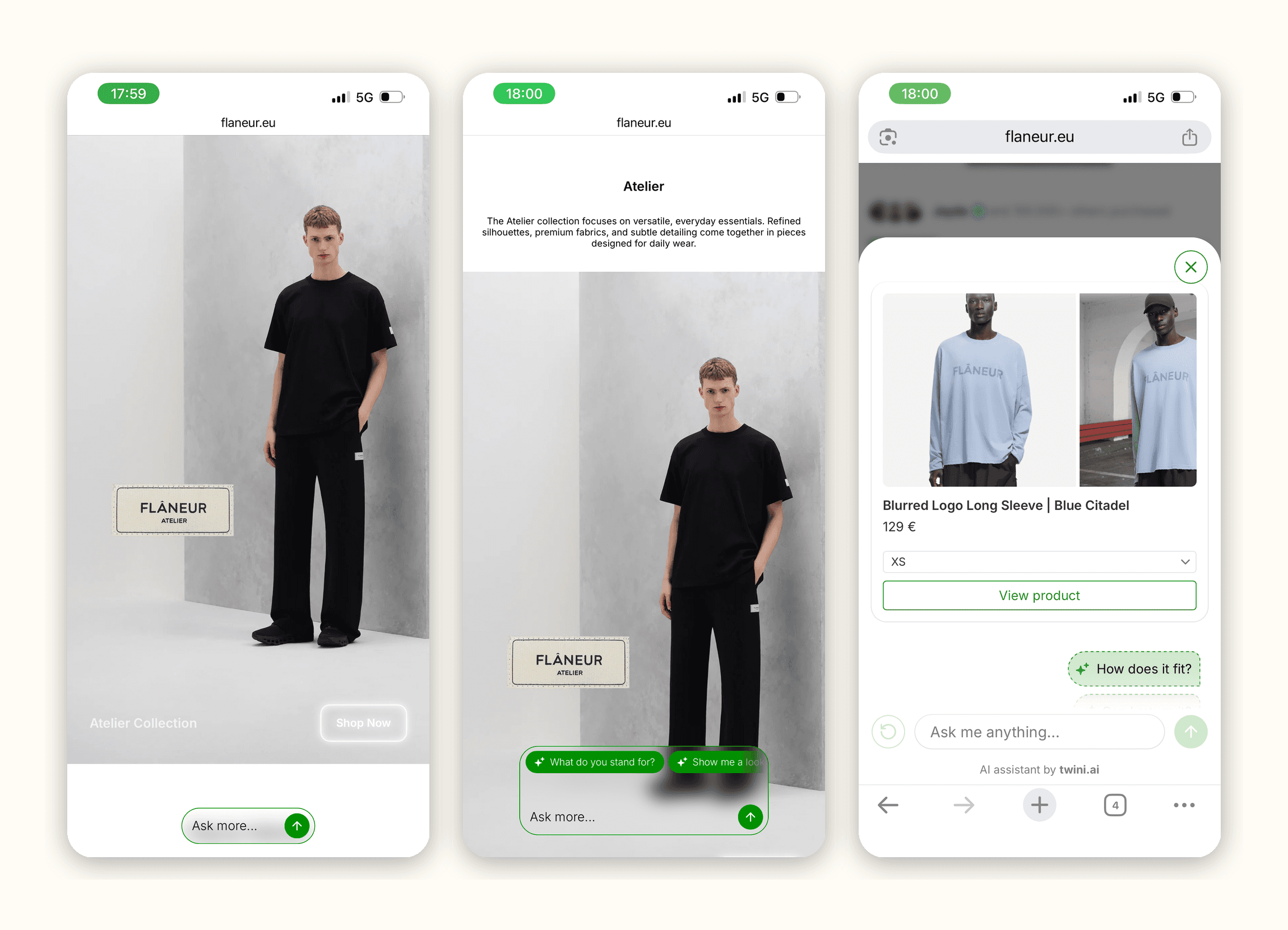
So FLÂNEUR put Twini on its product pages: an AI assistant trained on the whole catalogue that answers in the moment, in the shopper's market and language. It recommends a size from how someone usually fits and what the model wears, explains fabrics and fit, and handles delivery, returns and restock questions.
Then it does what a good store stylist does: it builds the outfit. Ask "what should I wear this with?" on a long sleeve, and Twini suggests the pieces that match it, tailored trousers for a refined look, relaxed denim for a washed one, straight from the live catalogue. Discovery keeps going after the question is answered, which is exactly where cross-sell comes from.
Eleven thousand conversations, straight to the cart
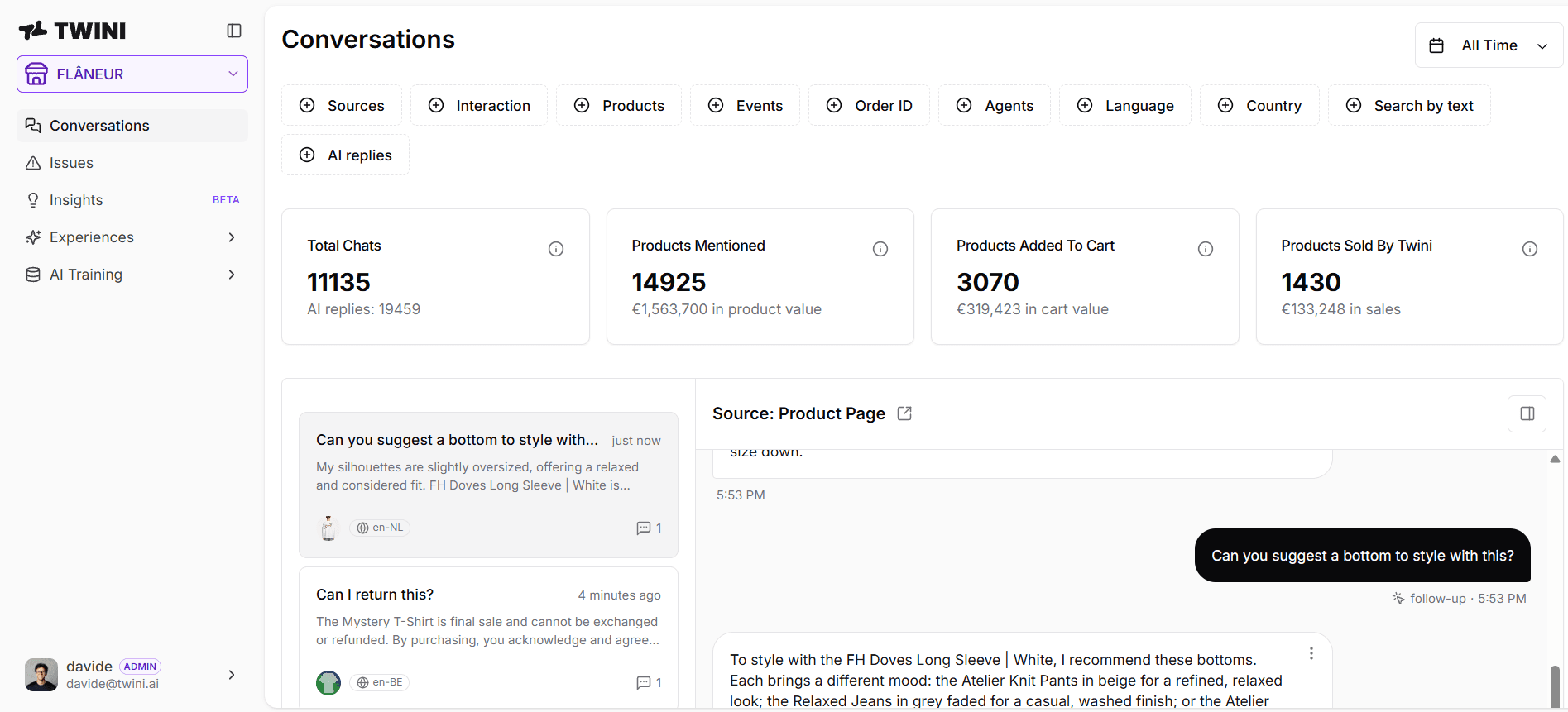
Since going live, Twini has handled 11,135 conversations and answered 19,459 times, recommending products 14,925 times across FLÂNEUR's markets. The intent shows in the cart: 3,070 products added from chat, more than one conversation in four, and 1,430 products sold directly attributed to Twini. On premium pieces, the shopper who gets a real answer about fit is the shopper who checks out.
"Sizing was our biggest source of doubt, and doubt was our biggest source of returns. Now every page answers like our boutique staff would, and the add-to-cart numbers prove it" — Regi Schalks, Founder at FLÂNEUR
A map of demand, product by product
With this volume, the conversations become an asset of their own. Twini turns them into two live views.
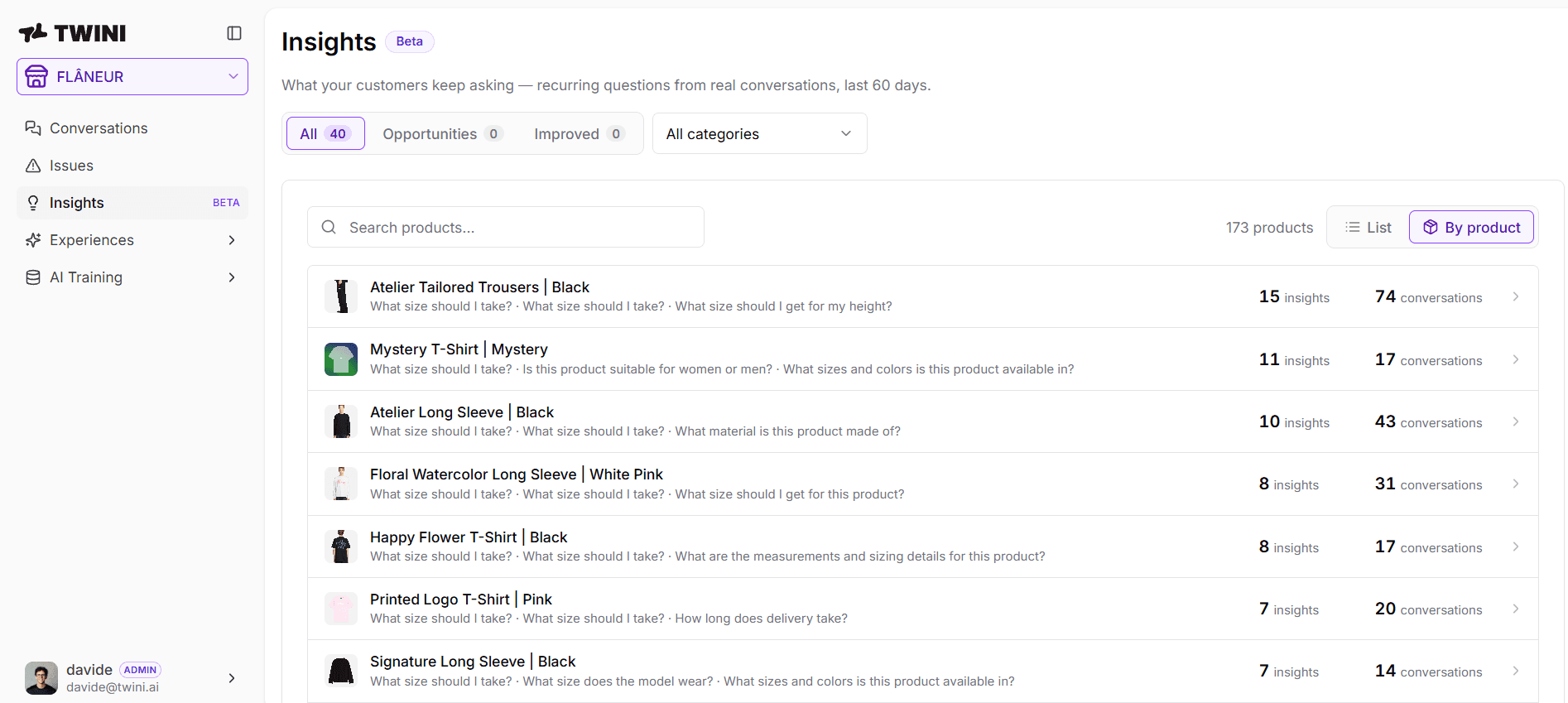
Insights, by product. Twini clusters recurring questions from real chats and breaks them down per garment, across all 173 products. The Atelier Tailored Trousers alone: 74 conversations, 15 recurring questions, led by "what size should I take?" and "what size should I get for my height?". Every product page now comes with its own list of what shoppers actually want to know, which is exactly the content that page should carry, for shoppers, for Google, and for AI search.
Issues. From the same chats, Twini flags what's missing. For FLÂNEUR the list reads like a product-page fix list: dimensions not specified (49 conversations), size chart not available (30), material composition not specified (19), model size and height not specified (5), plus fulfillment flags like orders arriving late. Each one is a concrete gap, with the number of shoppers who hit it, ready to review and resolve.
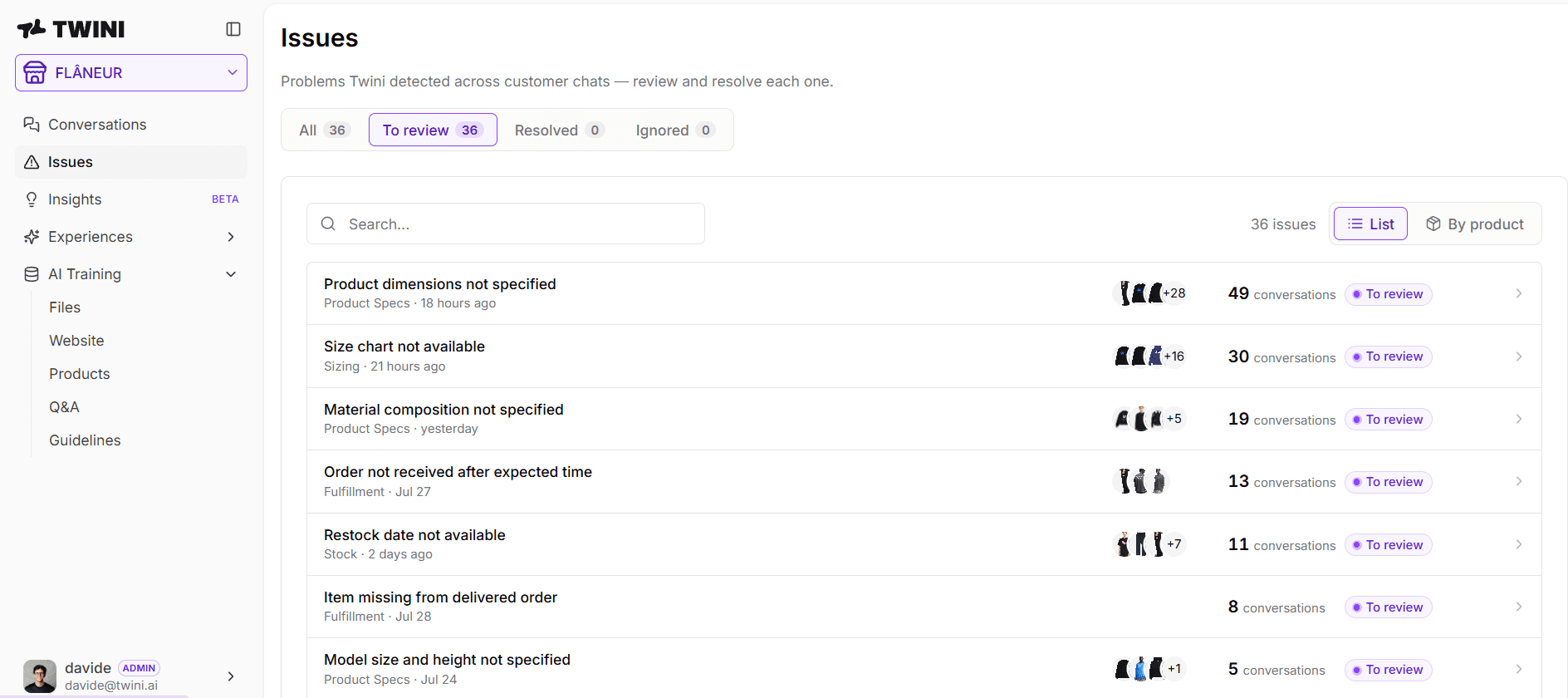
The loop is the point. Twini answers the question today, tells FLÂNEUR which page to fix tomorrow, and every fix makes the store, and the assistant, better with the next drop.

Twini S.r.l. | P.IVA IT13697330960 | Via Pietro Paleocapa 7, 20121, Milano (MI) | P.IVA IT13697330960 | MI - 2739354
Crafted in Milan with ❤️ © 2026